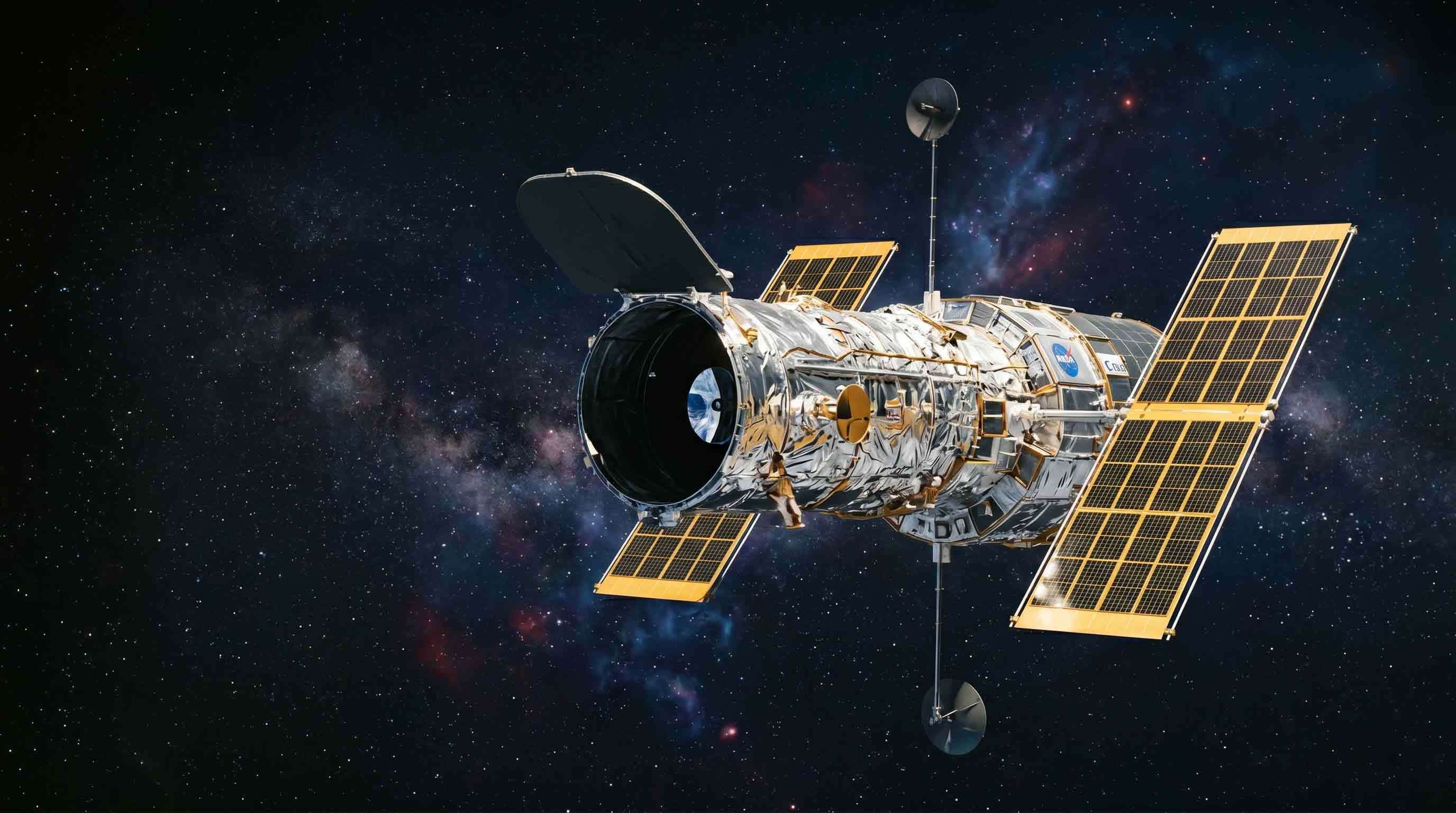
The Hubble Space Telescope is one of the most important scientific instruments ever created by humanity. Since its launch into space in 1990, Hubble has transformed humanity’s understanding of the universe by capturing breathtaking images of distant galaxies, stars, nebulae, and planets. Unlike telescopes on Earth, Hubble operates above the atmosphere, allowing it to observe space with extraordinary clarity and precision. Its discoveries have influenced astronomy, physics, cosmology, and public imagination, making it one of the most famous scientific achievements in modern history.
The Idea Behind the Hubble Telescope
The idea of placing a telescope in space existed long before the Hubble Space Telescope became reality. Scientists realized that Earth’s atmosphere distorts and blocks portions of light coming from distant objects in space, reducing the quality of observations made from ground-based telescopes. By placing a telescope above the atmosphere, astronomers could capture clearer images and detect forms of light that cannot easily reach Earth’s surface. The concept gained serious attention during the twentieth century as technology advanced and space exploration became possible through developments led by organizations such as NASA and the European Space Agency.
Development and Construction of Hubble
The development of the Hubble Space Telescope required decades of planning, engineering, scientific cooperation, and financial investment. Scientists and engineers designed Hubble to function as a large observatory orbiting Earth while carrying advanced instruments capable of studying stars, galaxies, black holes, and distant cosmic events. Construction began during the 1970s and involved thousands of researchers, technicians, and aerospace specialists working together on one of the most ambitious scientific projects ever attempted. The telescope was named after Edwin Hubble, whose observations helped prove that the universe is expanding beyond the boundaries of the Milky Way galaxy.
The Launch Into Space
The Hubble Space Telescope was launched into orbit on April 24, 1990, aboard the Space Shuttle Discovery during the STS-31 mission. The launch marked a historic moment in space exploration because scientists hoped Hubble would revolutionize astronomy by providing images and data unlike anything previously achieved. After reaching orbit approximately 547 kilometers above Earth, Hubble began transmitting observations back to scientists on the ground. However, shortly after deployment, researchers discovered a serious flaw in the telescope’s primary mirror, causing images to appear blurry and threatening the success of the entire mission.
The Mirror Problem and Repair Mission
The discovery of Hubble’s mirror defect became one of the greatest engineering crises in the history of space exploration because the telescope had cost billions of dollars and represented decades of scientific effort. Engineers eventually determined that the mirror had been ground incorrectly by a tiny fraction of a millimeter, creating distorted images. To solve the problem, NASA organized a complex repair mission in 1993 using astronauts aboard the Space Shuttle Endeavour. During several spacewalks, astronauts installed corrective optics and upgraded instruments, successfully transforming Hubble into the powerful observatory scientists originally envisioned.
How Hubble Works in Space
The Hubble Space Telescope operates by collecting light from distant objects using a large curved mirror that focuses the light onto sensitive scientific instruments and cameras. Hubble observes visible light, ultraviolet light, and portions of infrared light, allowing scientists to study many different cosmic phenomena. The telescope orbits Earth at high speed, completing one orbit approximately every ninety-seven minutes while continuously capturing data and images. Information collected by Hubble is transmitted to Earth through communication satellites, where scientists analyze the observations to study the structure, age, and evolution of the universe.
Hubble’s Stunning Images
One reason Hubble became famous worldwide is the extraordinary beauty of the images it captured throughout its mission. Photographs of colorful nebulae, spiral galaxies, star clusters, and distant cosmic explosions inspired millions of people and increased public interest in astronomy and science. Images such as the Pillars of Creation inside the Eagle Nebula became iconic symbols of space exploration and scientific discovery. Hubble’s photographs not only provided artistic inspiration but also delivered valuable scientific information about star formation, galactic evolution, and the chemical composition of distant regions of space.
Discovering the Age of the Universe
One of Hubble’s greatest scientific contributions was helping astronomers calculate the age of the universe with far greater accuracy than previously possible. By observing distant galaxies and measuring how quickly they move away from Earth, scientists refined calculations connected to cosmic expansion. Hubble’s observations supported the theory that the universe began with the Big Bang billions of years ago and allowed astronomers to estimate the universe’s age at approximately 13.8 billion years. These discoveries represented a major advancement in cosmology and improved humanity’s understanding of the origin and development of the cosmos.
Evidence for Black Holes
The Hubble Space Telescope provided important evidence supporting the existence of supermassive black holes at the centers of galaxies. By observing the movement of stars and gas near galactic centers, Hubble detected gravitational effects too powerful to be explained by visible matter alone. These observations strengthened scientific understanding of black holes as extremely dense regions where gravity is so intense that even light cannot escape. Hubble’s data helped astronomers realize that supermassive black holes likely exist in most large galaxies, including the Milky Way, changing theories about galaxy formation and evolution.
Studying Distant Galaxies
Hubble allowed scientists to look deeper into space than ever before, effectively observing ancient galaxies formed shortly after the birth of the universe. Because light from distant objects takes billions of years to reach Earth, observing these galaxies allows astronomers to study the early universe and understand how galaxies evolved over time. One of Hubble’s most famous achievements was the Hubble Deep Field image, which revealed thousands of galaxies within a tiny region of seemingly empty space. This discovery demonstrated the enormous scale of the universe and showed that galaxies exist in unimaginable numbers across the cosmos.
Observing Planets and Exoplanets
Although Hubble primarily studies distant cosmic objects, it has also made important contributions to planetary science and the study of worlds beyond the solar system. Hubble observed weather patterns on planets such as Jupiter, Saturn, Uranus, and Neptune while also studying moons, comets, and asteroids. The telescope contributed to the growing field of exoplanet research by helping scientists analyze atmospheres surrounding planets orbiting distant stars. These observations increased understanding of planetary systems and raised important questions about the possibility of life existing elsewhere in the universe.
Servicing Missions and Upgrades
One unique feature of the Hubble Space Telescope was its ability to be repaired and upgraded by astronauts during servicing missions. Between 1993 and 2009, astronauts conducted multiple missions to replace scientific instruments, install new cameras, repair damaged components, and improve overall performance. These servicing missions extended Hubble’s lifespan far beyond original expectations and allowed the telescope to remain scientifically productive for decades. The missions also demonstrated extraordinary achievements in human spaceflight because astronauts performed complex repairs while orbiting Earth at extremely high speeds.
Hubble’s Influence on Science and Culture
The influence of the Hubble Space Telescope extends far beyond astronomy because it changed how humanity views the universe and our place within it. Hubble images appeared in textbooks, museums, documentaries, films, and classrooms around the world, inspiring future generations of scientists, engineers, and space enthusiasts. The telescope became a symbol of international scientific cooperation and human curiosity, proving that technological innovation can dramatically expand human knowledge. Hubble also strengthened public support for scientific exploration by showing that space research produces discoveries capable of transforming our understanding of reality itself.
The Future Beyond Hubble
Although the Hubble Space Telescope remains operational after more than three decades in orbit, newer observatories are gradually taking over some of its scientific responsibilities. The James Webb Space Telescope was launched to study the universe with even greater sensitivity, especially in infrared wavelengths capable of observing extremely distant galaxies and star-forming regions. Despite this transition, Hubble continues to operate and remains one of the most valuable scientific instruments ever built. Scientists hope the telescope will continue functioning for several more years while contributing additional discoveries about the universe.
Conclusion
The Hubble Space Telescope represents one of humanity’s greatest scientific achievements because it transformed astronomy, expanded human knowledge, and revealed the astonishing beauty of the universe in unprecedented detail. From discovering distant galaxies and studying black holes to calculating the age of the universe, Hubble changed the way humans understand space and cosmic history. Its mission demonstrated the power of science, engineering, and international cooperation while inspiring millions of people to look toward the stars with curiosity and wonder.